What the Term Solar Cable Means in Different Markets
The same two words describe a different object in Rotterdam, Houston and Sydney, because what changes is not the copper but the standard printed on the certificate and the drum marking that follows it. KUKA CABLE sells one family of PV cable into more than 120 countries under several designations, and its own pages show how the naming works: H1Z2Z2-K, PV1-F and UL 4703 PV wire each sit on a page of their own, with TUV 2PfG 1169/08.2007, EN 50618:2014 and IEC 62930 named against the construction. Buying cable solar by description alone is how a project ends up with the right cable and the wrong paperwork.
Key takeaways
- Designations differ by market: H1Z2Z2-K, PV1-F and UL 4703 PV wire are three published names for PV cable constructions on the manufacturer's site.
- Standards are named alongside the construction - TUV 2PfG 1169/08.2007, EN 50618:2014 and IEC 62930 - so the designation alone does not fix the test regime.
- The published rated voltage is DC 1.8/1.8 kV, which is why a project described as 1500 V has headroom inside the cable rating (1,800 divided by 1,500 is 1.2; my own arithmetic).
- Regional requirements the manufacturer highlights are the CPR fire rating and the AD8 waterproofing rating, so a specification that omits them is incomplete in those markets.
One family, several names
The manufacturer's solar range is published under a set of designations rather than a single title. H1Z2Z2-K has its own page. PV1-F has its own page and appears in the certificates listing tied to TUV EN 50618. UL 4703 PV wire has a page of its own for the North American route. Beside them sit product pages for a 1500 V solar cable in 6 mm², twin-core solar cable and a TUV solar cable in 4 mm² and 6 mm².
Those names are not decorative. A designation usually implies a construction and a test regime, and where it does not, the standard written beside it does. The same manufacturer states that its solar cables are certified by TUV, IEC, CPR and others, and that its certificates listing covers more than 30 types including TUV, IEC, CE, SAA and UL. A buyer importing into a new market should read that list before reading the product description.
Voltage labels are not interchangeable
A project described as 1,500 V and a cable rated at 1.8/1.8 kV DC are talking about different things. The first is a system class, the second is the insulation rating published for this construction. The margin between them is 300 V, which is a fifth of the system figure (1,800 minus 1,500 equals 300; 300 divided by 1,500 is 0.2; my own arithmetic, assuming the system label refers to the string voltage).
That margin is the reason a cable rated for the higher figure can be used on a lower-voltage system without argument, and the reason the reverse cannot be assumed. The published electrical window also includes a 6.5 kV AC test at 50 Hz for 5 minutes on the finished cable and a 10 kV spark test during production, which are the figures a test engineer should ask to see for the batch.
Sizes and cores travel differently
The commonly used sizes are 4 mm², 6 mm² and 10 mm² in single-core and twin-core versions, and the published cross-section table runs from 1.5 mm² to 240 mm². Twin-core constructions are common where two conductors run together in a domestic or small commercial job, while utility-scale work usually uses single-core cable pulled in trays or ducts.
Conductor construction also changes with size in a way that matters across markets: 0.25 mm strands in the two smallest sizes, 0.29 mm strands from 4 mm² to 70 mm², and 0.39 mm strands from 95 mm² upward. A datasheet from another market that lists a different strand pattern is describing a different conductor flexibility, whatever the nominal area says.
What to check on a datasheet from another market
Six items cover the difference between one market and the next. Read them in order and the cable stops being a generic purchase.
- The designation and the standard printed against it, not the marketing title of the page.
- The rated voltage: published here as DC 1.8/1.8 kV, which is a cable rating rather than a system class.
- The conductor: tinned copper, class 5 flexible to IEC 60228, with the strand count for the size in question.
- The wall thickness: 0.7 mm of insulation and 0.8 mm of sheath through 10 mm², rising to 0.9-1.7 mm and 0.8-1.7 mm above it.
- The mechanical limits: a minimum bend radius of 4 times the outer diameter and elongation of at least 125%.
- The regional requirements: CPR fire rating and AD8 waterproofing where the local rule asks for them.
| Term as used in a specification | Standard named with it by the manufacturer | What a buyer should verify |
|---|---|---|
| H1Z2Z2-K | European PV cable designation | The test values on the certificate and the drum marking |
| PV1-F | Listed alongside TUV EN 50618 | Which standard the certificate quotes for the batch |
| UL 4703 PV wire | North American route | Conductor stranding and the approval document |
| IEC 62930 | Named on the 1500 V, 6 mm² page | Test voltage and the service-life statement quoted |
| CPR fire rating | Regional requirement highlighted by the manufacturer | The fire class demanded by the local rule |
| AD8 waterproofing | Regional requirement highlighted by the manufacturer | Whether the rating covers the cable or the joint |
Worked example
Take the rated voltage published for the 1500 V construction: DC 1.8/1.8 kV. Against a system class of 1,500 V the headroom is 300 V, which is 1.2 times the system figure when the two are divided (1,800 divided by 1,500 equals 1.2; my own arithmetic, assuming the project label states string voltage). The same calculation against a 1,000 V system gives 1.8 times, which is my own figure again. The point of doing it is to keep the cable rating and the system class in separate columns on the datasheet.
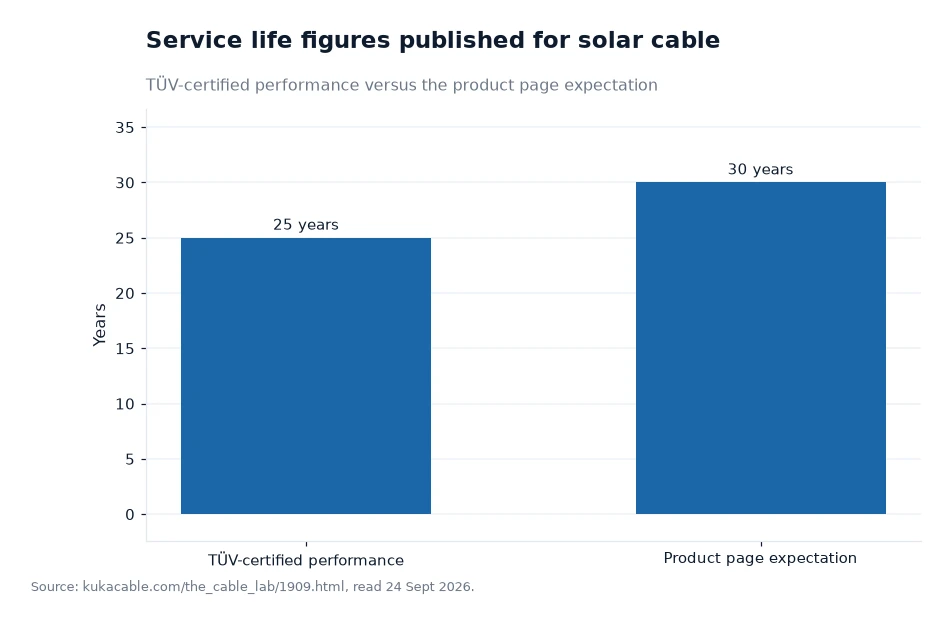
The service-life figures behave in a similar way when two markets compare notes. The manufacturer's certification page describes TUV-certified cable as holding performance for more than 25 years, while a product page states an expected service life of 30 years, so a specification written in one market and a datasheet quoted in another can differ by five years before anyone has changed the product. Ask which page the quoted figure comes from, and record the answer with the certificate.
Frequently asked questions
Is solar cable a single product or several?
Several, described by designations that carry different paperwork. The manufacturer's pages show H1Z2Z2-K, PV1-F and UL 4703 PV wire as separate lines, with standards such as TUV 2PfG 1169/08.2007, EN 50618:2014 and IEC 62930 named against the construction, and regional requirements such as the CPR fire rating and the AD8 waterproofing rating highlighted where they apply. A specification should name the designation and the standard, not just the application.
What should a datasheet from a new market show?
The designation and the standard printed against it, the rated voltage - published for this range as DC 1.8/1.8 kV - the conductor construction with the strand count for the size, the insulation and sheath thickness, the minimum bend radius of 4 times the outer diameter, elongation of at least 125%, and the regional requirements such as CPR and AD8 where the local rule asks for them. Anything missing from that list should be requested from the supplier in writing.
Putting the name back into the specification
Write the designation, the standard, the size and the length on the purchase order, then ask for the certificate that matches, the cross-section table for the sizes ordered and a sample end to compare with the drawing. The manufacturer publishes a solar cable section with a page for each designation, data sheets and a catalogue for download, and a product consultant who can confirm which certificate applies to your market before the order is placed. A cable that arrives with the right cable inside the wrong paperwork is still the wrong delivery.
Nothing above is market research: the figures are the manufacturer's own, published on its website, with the service-life numbers captured 24 Sept 2026[1].