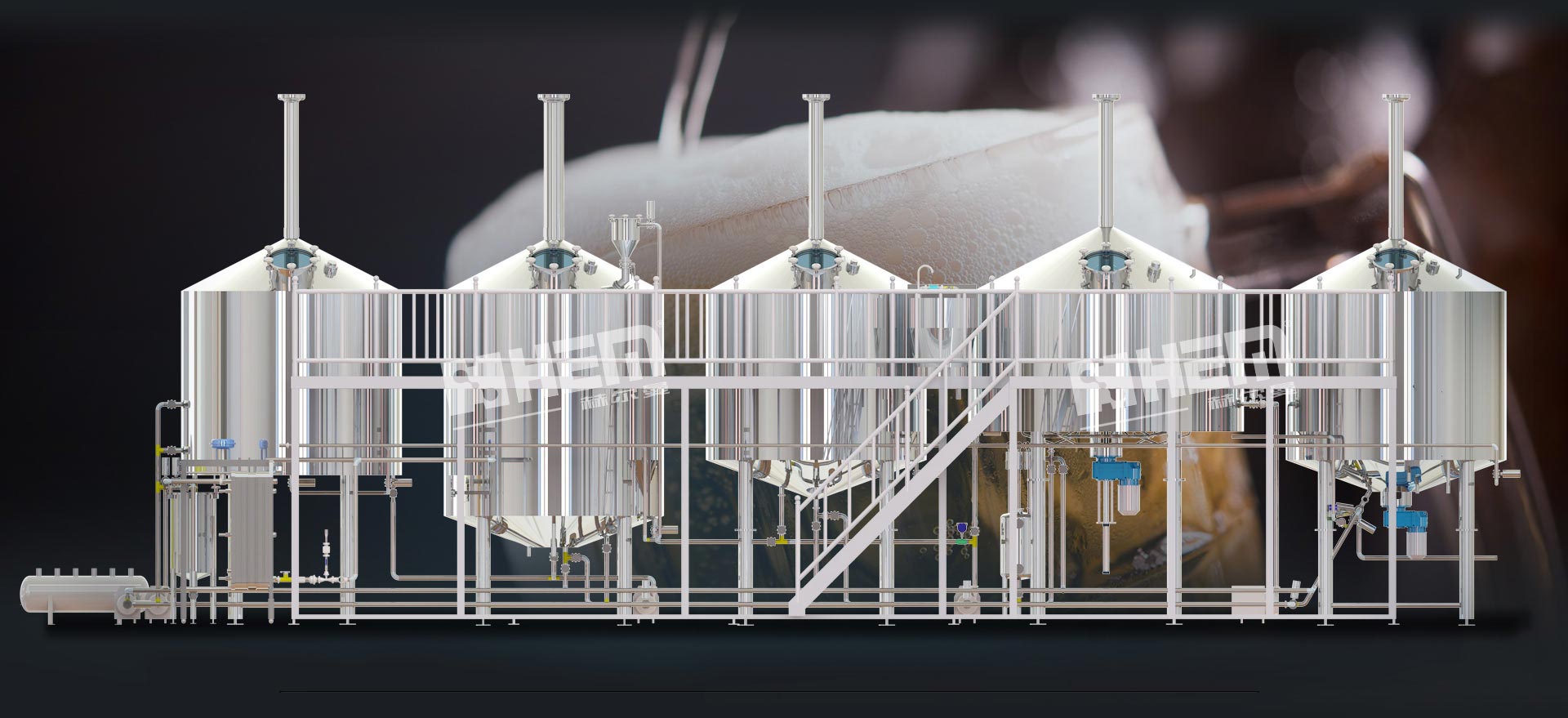
A hem brew system can save brewing time mainly by reducing manual handling, shortening the gaps between heating, mashing, boiling, transfer, and cleaning, and giving the brewer more consistent control over each batch. The time gain is not limited to faster heating. A 2021 CIP study found that a 35-minute caustic cleaning cycle could provide effective cleaning under tested conditions, while earlier MBAA work documented a sanitation case where CIP time fell from 3 hours to 1 hour. When temperature control, pumps, process timing, and cleaning are better coordinated, even a 10–20% reduction in non-brewing time can open useful production capacity across repeated weekly batches.
Brewing time has to be measured beyond the mash and boil. A normal production day includes filling vessels, heating liquor, milling and loading malt, recirculating wort, lautering, boiling, whirlpooling, cooling, transferring, rinsing, and preparing equipment for the next batch. A brewer may therefore spend a large part of an 8–10-hour shift on work that does not directly change the wort. The Brewers Association separates brewery production into brewhouse, cleaning, fermentation, cellaring, filtration, sanitation, and packaging operations, which is a useful way to see where working hours actually go.
That wider view makes small delays worth measuring. Suppose a brewery makes three batches in a day and loses 12 minutes to manual valve changes, 15 minutes waiting for temperature corrections, and another 13 minutes around transfer preparation per batch. That is 40 minutes per batch, or 120 minutes across three batches. Recover only 25% of those two hours, and the brewery gets 30 minutes back without changing mash chemistry, boil requirements, or the recipe.
A hem brew system can address part of that time through coordinated equipment operation rather than asking an operator to treat every pump, vessel, heating step, and transfer as an isolated job. A brewer still sets the process requirements and checks product quality, but routine equipment operations can require less repeated physical input. In a 2024 MBAA program on brewery cleaning, sensors and PLC-based control were specifically identified as tools for measuring and controlling CIP cycles.
Automation should not be counted as “minutes removed from brewing chemistry.” Its useful measurement is operator minutes removed from repetitive equipment work and waiting.
Temperature management provides a good example. Mash rests have to remain within the range selected for the recipe, while wort eventually has to reach the required boil conditions. A manually managed brewhouse can require repeated checks followed by heater or flow adjustments. If five checks consume only 2 minutes each, one batch already contains 10 minutes of operator attention. Across 15 batches per week, that becomes 150 minutes, before counting walking between vessels or correcting overshoot.
Heating performance also affects scheduling because brewing loads are not constant. MBAA technical literature describes brewing, pasteurization, and CIP as intermittent processes with changing heating demand; conventional high-mass boiler systems can experience lag or overshoot when responding to those changes. In a 2013 MBAA technical publication, industrial boiler systems were described as accounting for nearly half of industrial energy consumption, showing why heating should be treated as both a time and utility issue rather than merely a temperature setting.
Once the target temperature is reached, repeatability becomes more important than chasing maximum speed. If Batch A reaches its next stage in 42 minutes but Batch B takes 58 minutes because of inconsistent setup, a production manager cannot reliably schedule the second vessel or the next transfer. Reducing that 16-minute spread by 50% may be more useful than making the fastest batch two minutes quicker because the working day becomes easier to plan.
Process repeatability also reduces recipe setup. A brewery making the same pale ale 20 times does not gain much from having an operator manually recreate every established time and temperature instruction. Stored or standardized process settings can reduce repeated entry and lower the chance of a missed step. The brewer can spend the recovered minutes checking gravity, pH, raw-material condition, or sensory quality instead.
| Production task | Manual time exposure | Time-saving approach |
|---|---|---|
| Temperature checks | 5–15 min/batch | Centralized monitoring |
| Pump and valve changes | 5–20 min/batch | Coordinated process control |
| Recipe setup | 5–10 min/batch | Repeatable settings |
| Transfer preparation | 10–20 min/batch | Planned flow paths |
| CIP supervision | 20–60+ min/cycle | Controlled cleaning sequence |
The ranges above are operational examples rather than guaranteed Hem specifications because actual time depends on brewery layout, batch volume, piping, utilities, recipes, and staff practices. A brewery should record its own baseline for at least 10–20 batches before calculating a credible labor-saving percentage. Comparing one unusually fast automated batch with one unusually slow manual batch gives poor planning data.
Transfer time deserves separate measurement. MBAA technical material notes that efficient material routing contributes to brewery productivity and that incorrect routing can contaminate or mix incompatible materials. A brewer therefore cannot simply open valves faster to save five minutes. Flow paths have to be correct, sanitary, and known before wort or beer moves between vessels.
A more organized hem brew system setup can reduce the work surrounding a transfer: identifying the route, preparing the receiving vessel, starting the pump, watching the flow, and closing the correct path afterward. If preparation falls from 18 minutes to 10 minutes, an 8-minute saving repeated across 12 weekly transfers gives 96 minutes back. At 50 brewing weeks per year, the same routine difference represents about 80 labor hours, assuming the production schedule remains comparable.
Cleaning can produce an even larger difference because CIP occupies equipment that could otherwise be prepared for production. The Brewers Association describes CIP as a method for cleaning internal equipment surfaces without major disassembly, while MBAA describes four variables that have to be managed together: concentration, temperature, time, and mechanical effect. Cutting cleaning time without controlling those conditions is not sound brewery practice.
A 2021 study of microbrewery CIP procedures in northeast England provides useful numbers. Researchers used ATP swabs to evaluate cleanliness and reported a target of below 10–30 relative light units. Under the conditions tested, at least a 2% v/v caustic dilution with a 35-minute cleaning cycle was recommended, followed by a sterilization stage using 1% v/v dilution of 5% wt peracetic acid for at least 10 minutes.
The same study found that heating the caustic cycle to 40–60°C did not improve measured cleanliness over 10–20°C ambient-temperature water during the tested 35-minute cycle. It also reported that a single 100 L rinse was adequate for vessels up to 1,200 L under the study conditions. Those numbers should not be copied blindly into another brewery’s SOP, but they show why measured cleaning parameters can prevent unnecessary heating, rinsing, and waiting.
A shorter CIP cycle is useful only when the required cleanliness is still achieved. Time saved by under-cleaning can be lost many times over if a vessel has to be cleaned again or product quality is affected.
Historical industrial data show how large the time component can become. An MBAA technical paper reported a large bottling-plant application where a cold ozone CIP process reduced sanitation time from 3 hours to 1 hour, a 66.7% reduction. The reported plant efficiency improvement was 4.1%, alongside better microbiological test results in that particular installation. It was a specific industrial case, not a performance claim for every brewery or for Hem equipment.
Water handling is closely connected to cleaning time. Brewers Association guidance reports a brewery water-use dataset with a sample size of N=211 and a 2010 range of 3.26–7.44 liters of water per liter of beer. The reported benchmark moved from 4.74 to 4.28 L/L, roughly a 10% improvement. Cleaning, cellars, packaging, utilities, and the brewhouse all contribute to that total.
Less unnecessary rinse water can also shorten the time pumps and vessels remain occupied. Brewers Association guidance notes that moving from manual CIP toward automated CIP with rinse-water recycling can provide significant water and chemical savings. MBAA's 2020 small-brewery sustainability work similarly notes that multi-tank CIP skids can reuse cleaning and sanitation chemicals when pH, turbidity, and effective chemical concentration are monitored after a cycle.
The labor calculation can then be separated from equipment cycle time. If an automated stage lasts 45 minutes but requires only 5 minutes of operator involvement, the brewer has 40 minutes available for milling, raw-material preparation, gravity measurements, record keeping, cellar work, or preparing another vessel. Saving operator time can therefore matter even when the actual physical process remains 100% of its original duration.
For a small brewery, that distinction affects staffing. Assume one brewer handles two batches during a 9-hour day. Removing 15 minutes of active monitoring, 10 minutes of transfer handling, and 20 minutes of cleaning-related work per batch frees 45 minutes. Two batches provide 90 minutes. Across four brewing days per week, that becomes 6 hours; across 48 production weeks, it reaches 288 operator hours per year.
Those 288 hours should not automatically be presented as additional beer production. Fermenter availability, cellar capacity, chilling capacity, packaging schedules, labor coverage, and raw-material preparation can still limit output. The better test is to record vessel occupancy and operator involvement separately, then determine whether recovered time actually allows another task or batch to start earlier.
A practical time study can use six measurements for every batch:
-
Record heat-up time from the same starting and target temperatures.
-
Record active operator minutes during mash and boil.
-
Measure every transfer from setup through completion.
-
Log waiting periods longer than 5 minutes and their causes.
-
Record CIP duration, rinse volume, and operator attendance.
-
Repeat the measurement across at least 20 batches before comparing averages.
Twenty batches provide 20 observations rather than a single anecdote and can expose recipe-related differences. If manual batches average 510 minutes from setup through post-brew cleaning and the comparable controlled workflow averages 455 minutes, the measured reduction is 55 minutes, or about 10.8%. If operator attendance falls from 240 to 180 minutes, labor involvement falls 25%, even though total elapsed time falls by a smaller percentage.
The hem brew system should therefore be evaluated using both numbers: elapsed batch time and active operator time. A brewery that saves only 8% in total cycle time but cuts repetitive operator involvement by 20% may gain more usable working capacity than a system that heats rapidly but still requires frequent manual transfers and supervision.
Production records provide the final check. Compare at least 2025–2026-style operating data by recipe: start time, strike-water readiness, mash completion, transfer duration, boil start, knockout time, CIP finish, water consumption, and active labor minutes. A stable 10–15% reduction across 20 or more comparable batches is much stronger operational support than a single fast brew day, and it gives the brewery a realistic number for scheduling the next production run.